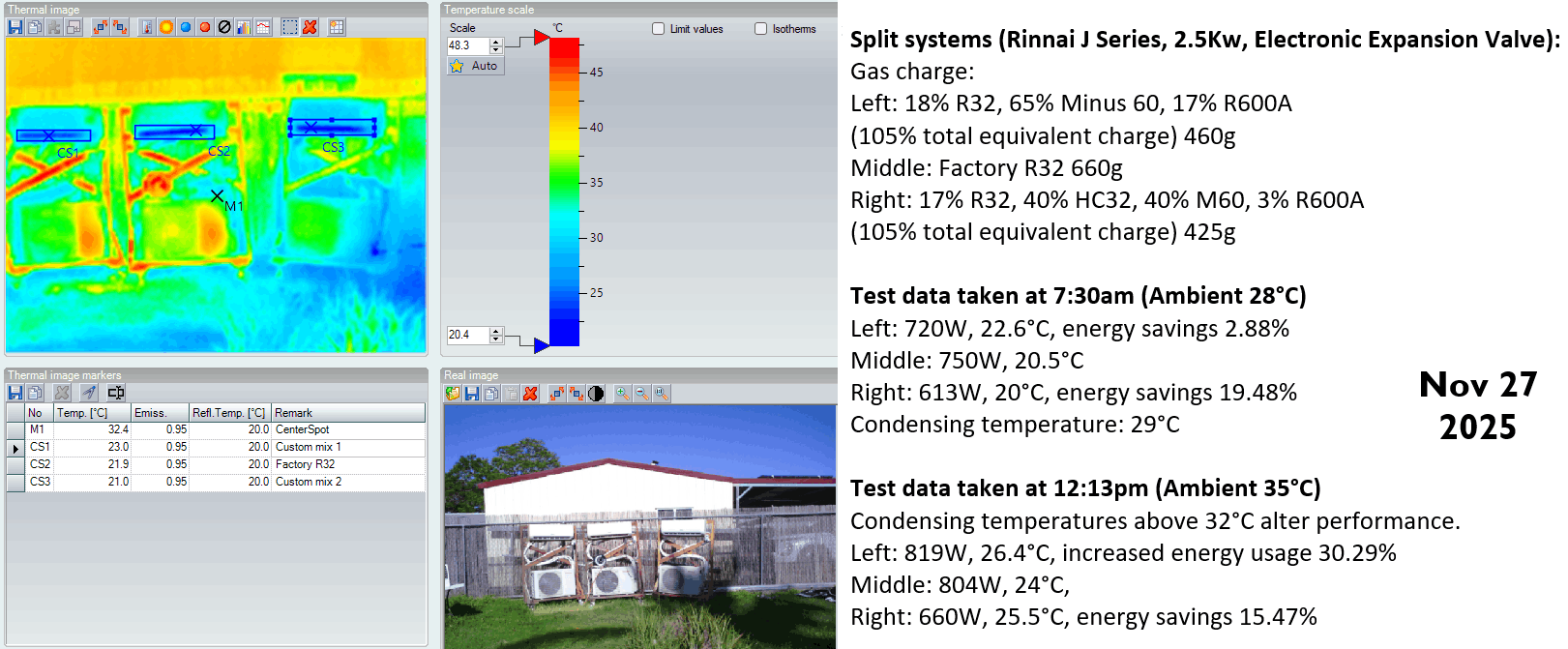
Test data
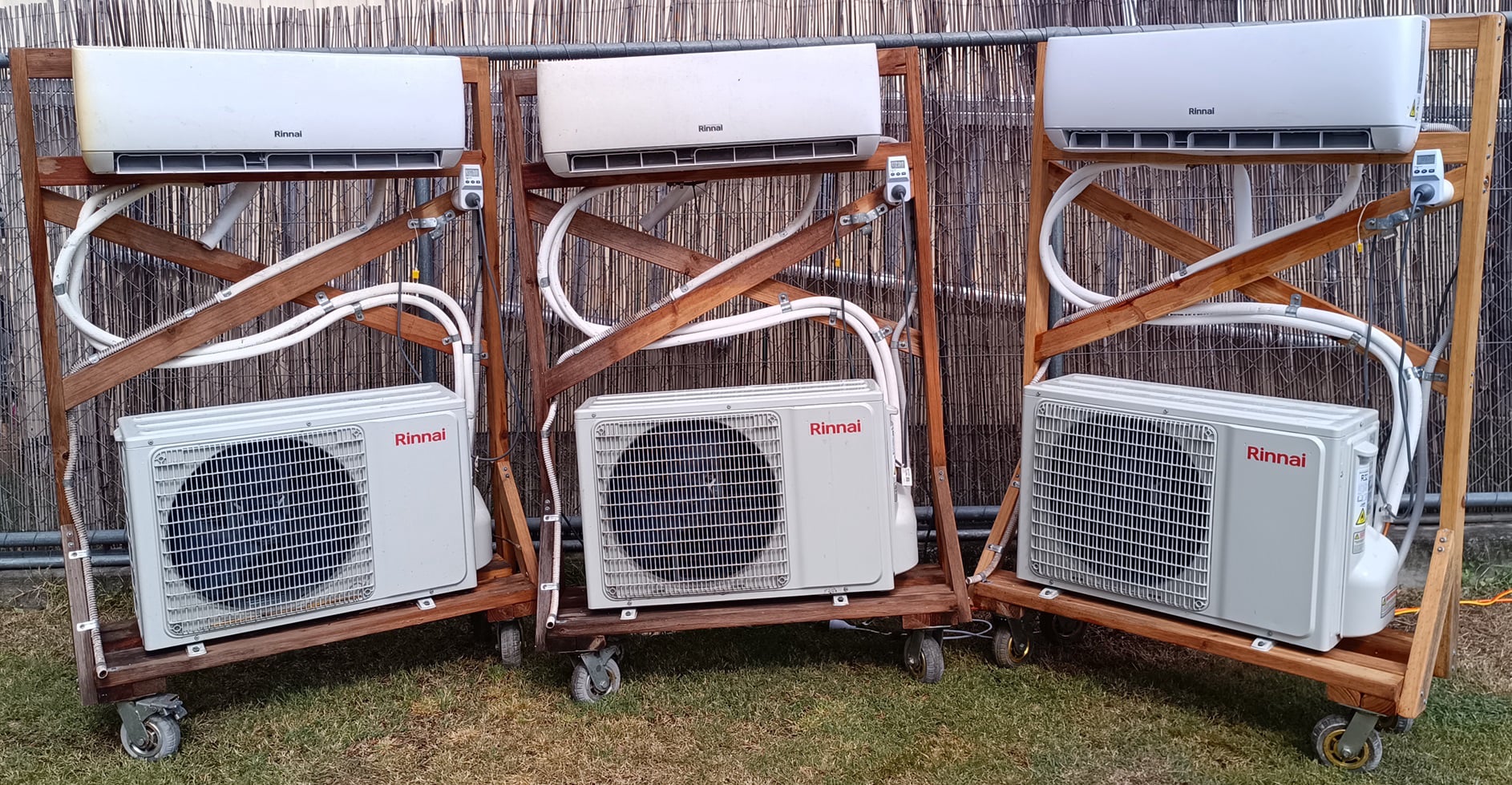
The test rigs:
These tests aren't endorsed by Engas or Hychill, and are of my own doing. The goons in the QLD government know I have these systems.
I have 3 split system air conditioners which I can wheel around and plug in to an ordinary power point.
These are the Rinnai J Series 2.5Kw, reverse cycle, inverter models.
These are run with the same fan speed and the same temperature settings.
I am able to measure either the temperature of the gas pipes on the back of the outdoor units, or the air coming out of the vents.
I have plug in meters for measuring instantaneous power loading.
Products under test:
One air conditioner contains the R32 refrigerant gas that the manufacturer intends to be used with the system.
Engas and Hychill are competing brands of hydrocarbon refrigerant manufacturers.
Engas are based in Western Australia and mainly target hotter climates. Their gas is also used in Pioneer branded air conditioners.
Hychill are based in Melbourne and automotive air conditioning is their main target.
Which one is the best?
In my opinion, it's whatever you can easily get your hands on and mix in some R32 gas. I go into detail and reasons why on another page. This could potentially change in the coming months / years as new products are being developed.
Early testing:
My initial tests compared the factory R32 gas against Engas M20 and Hychill HC32. I followed their recommendations for gas charge.
The photo shows heating tests in winter.
You'll see there's a vast difference in performance. Hychill HC32 contains a small portion of Ethane (R170), which picks up heat really easily.
Initial cooling tests in summer using the same gas charges were nothing exciting to write home about. Energy savings were still noticeable, but critical performance slumped. With much research and spreadsheet production, I seem to have since fixed this.
Newer tests:
Storage has been an ongoing issue around here, so I haven't had any photo worthy setups. The place looked like a junk yard and I'm only just getting on top of it now.
I plan to release another documented photo this summer.
I've done my research and tests, and like any critical thinker, have come to my own opinions.
In short: Mix R32 with either Engas M20 (for R32 systems, or use Engas M60 for R410A system) or Hychill HC32 (suitable for either R410A or R32 systems). You may need to slightly overcharge the system by no more than 5%.
I have a R410A ducted air conditioner in Campbelltown NSW running a mixture of 25% R32 and 75% HC32 (not overcharged at all). It's theoretically undersized for the house but does the job. I re-gassed it on Christmas Day of 2024 and it cooled the house well on some of those hot days I was last there.
I've noticed with R32 systems that the manufacturers seem to understate the gas charge. I've found that by overcharging the system by no more than 5%, seems to restore performance (due to the evaporating temperature of the refrigerant gases). Most of the refrigerant gas stays on the high side of the system and I think the manufacturers understate their gas charges for their R32 systems.